1. The very question itself is revealing shifts in how we Consider the concept of coverage
For the better part of the last three decades debate about how to reach remote or underserved regions from above was considered a matter of choice between ground infrastructure and satellites. The growth of high altitude platforms has provided an alternative option that doesn't easily fit into any category this is what makes this a fascinating comparison. HAPS aren't trying to replace satellites everywhere. They're competing on specific use scenarios where the physics of operating at 20 kilometers instead of 35,000 or 500 kilometers yields significantly better results. Understanding the extent to which that advantage might be real and which areas it's not is the whole game.
2. In the battle for latency, HAPS win Clearly
The signal travel time is determined by distance. Distance is where stratospheric platforms enjoy the advantage of having a clear structural advantage over other orbital systems. A geostationary satellite is located approximately 35,786 kilometres above the equator. This results in circular latency that is around 600 milliseconds. That's enough for voice calls albeit with noticeable delay, but not suitable for real-time applications. Low Earth orbit constellations have dramatically improved this issue operating at 550 to 1,200 kilometers with latency in the 20 to 40 millisecond range. A HAPS vehicle travelling at 20 kms has latency rates equivalent for terrestrial networks. For those applications that require responsiveness like industrial control systems emergency communications, financial transactions, direct-to-cell connectivity -- that is not an issue.
3. Satellites Gain Global Coverage And That's What's Important
The stratospheric platform that is currently being developed can cover the entire earth. An individual HAPS vehicle covers a local footprint, which is massive by terrestrial standards, yet very limited. Achieving global coverage would require an entire network of platforms scattered around the globe, each one requiring its own operations the energy system, its own power source, and station-keeping. Satellite constellations, especially large LEO networks, can cover the globe with overlapping cover in ways stratospheric infrastructure isn't capable of replicating with current vehicles counts. For applications requiring truly universal coverage like maritime tracking, global messaging, and polar coverage, satellites are an option of the highest quality at the scale.
4. Resolution and Persistence Favor AAPS in Earth Observation
If the task involves monitoring a specific region continuously -for example, tracking methane emissions in an industrial corridor, monitoring an erupting wildfire take place in real time or monitoring the oil pollution expanding from an incident offshore The persistent, close-proximity nature of a stratospheric platform produces data quality that satellites are unable to attain. Satellites operating in low Earth orbit traverses any single point on the earth's surface for minutes or more at a time and the intervals of revisits are measured in days or hours based on constellation size. A HAPS vehicle holding position above the same region for a period of weeks offers continuous observation with sensor proximity that provides greater spatial resolution. To be used for stratospheric earth observation the persistence of this method is typically superior to global reach.
5. Payload Flexibility Is an HAPS Advantage Satellites. justly match
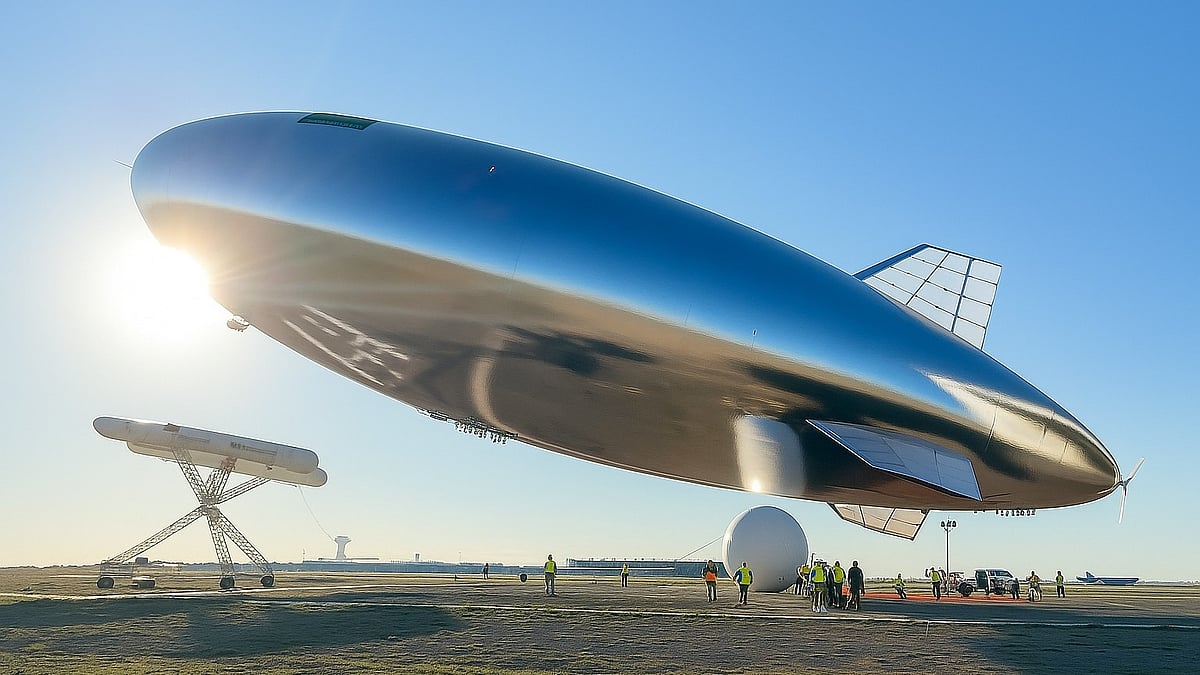
When a satellite is launched, its payload is fixed. The upgrading of sensors, the swapping of communication hardware, or adding new instruments will require the launch of completely new spacecraft. The stratospheric platform is returned to ground between missions This means that the payload is able to be upgraded, reconfigured or completely changed as demands for mission change or improved technology becomes available. Sceye's airship is specifically designed to support large payloads, which can allow combinations of telecommunications antennas, greenhouse gas sensors, and disaster detection systems all on the same platform This flexibility will require several satellites to replicate each with a distinct budget for their launch, as well an orbital slot.
6. The Cost Structure is Significantly Different
Launching a satellite involves the costs of rockets along with insurance, ground segment development and acceptance that hardware failures in orbit are a permanent write-off. Stratospheric platforms operate more like aircrafts. They are able to be recovered, examined or repaired before being repositioned. That doesn't necessarily mean they're less expensive than satellites on a per-coverage-area basis, but it impacts the risk profile and their upgrade cost significantly. For companies that are trying out new services also, as they enter markets, the capability to access and alter the platform rather of accepting hardware that orbits as a sunk-cost provides a significant operational advantage especially in the initial commercial phase that the HAPS industry is working through.
7. HAPS Could Act as 5G backhaul when satellites can't Effectively
The telecommunications technology enabled by the high-altitude platform station that operates as a HIBS or creating a cell-tower in the sky it is designed to integrate with existing internet standards for mobile phones in ways that satellite access didn't. Beamforming from a stratospheric telecom antenna is a way to dynamically allocate signals over a large coverage area and can support 5G backhaul existing infrastructure on ground and direct-todevice connections simultaneously. Satellite systems are now more efficient in this field, however being closer to the ground affords stratospheric systems an advantage in signal strength, frequency reuse, and compatibility to spectrum allocations designed for terrestrial networks.
8. The Operational Risk and Weather Variation Differ A lot between the Two
Satellites, once they have been placed in stable orbit, are largely indifferent to weather conditions on the terrestrial side. The HAPS vehicle that operates in the stratosphere confronts a more complicated operational environment such as stratospheric patterns of wind including temperature gradients and the engineering challenge of managing at night while still maintaining the station. The diurnal cycles, the daily rhythm of the solar energy availability and overnight power draw as a design constraint that all HAPS powered by solar power must tackle. The advancements in lithium-sulfur battery energy capacity and cell efficiency in solar panels are closing this gap, but it is the real operational problem that satellite operators do not face in the same form.
9. The truth is that They perform different tasks.
The idea of comparing satellites and HAPS as a competition that is winner-takes-all misses the extent to which infrastructure that is not terrestrial will evolve. The most accurate view is one of a multi-layered structure where satellites control global reach and applications where coverage universality overrides everything else in the stratospheric platform, while stratospheric platforms support regional persistence missions -connectivity for geographically difficult terrain, continuous environmental monitoring in disaster recovery, and the expansion of 5G into areas in which the terrestrial rollout isn't economically viable. Sceye's geographical positioning is based on this premise: a platform designed to do things in the region of a specific location, for longer periods of time, and with sensors and a communications payload that satellites don't have the capacity to replicate in that high altitude and close proximity.
10. The Competition Will Sharpen Eventually Both Technologies
It is possible to argue that the growth of reliable HAPS programmes has helped accelerate technological innovation through satellites, and in turn. LEO constellation operators have increased latencies and coverage in ways that raise the bar HAPS have to meet the requirements of competing. HAPS developers have demonstrated constant regional monitoring capabilities, which has prompted satellite operators consider revisit frequency and sensor resolution. For example, the Sceye and SoftBank collaboration targeting Japan's national HAPS network, which includes pre-commercial services set for 2026 is among the most clear signals yet that stratospheric platforms have gone from being a theoretical competitor into an active participant in influencing how the non-terrestrial network and observation market develops. Both technologies will be better for the demands. Read the top Sceye endurance for more tips including Direct-to-cell, what haps, investment in future tecnologies, stratospheric internet rollout begins offering coverage to remote regions, sceye haps airship specifications payload endurance, Stratospheric earth observation, Sceye endurance, Sceye Founder, Sceye stratospheric platforms, japan nation-wide network of softbank corp and more.
Mikkel Vestergaard's Vision Behind Sceye's Aerospace Mission
1. The Founding Vision of a company is often overlooked as a factor In Aerospace Company Outcomes
The aerospace sector creates two broad categories of companies. The first is built around a technology seeking applications which is an engineering skill in search of a marketplace. The second begins with a need that is significant and works backwards towards the technology to solve it. The distinction can seem abstract until you take a look at what each type of company does through partnerships, the type of partnerships it pursues and how it trade-offs when resources are constrained. Sceye falls in the second category, and understanding the significance of orientation is vital to know why the firm has made the particular design choices it has made -for example, lighter-than-air designs, multi-mission payloads, an emphasis on endurance, and a primary basis within New Mexico rather than the coastal aerospace clusters which attract large numbers of venture-backed space corporations.
2. The Issue Vestergaard started with was much bigger than Connectivity
The majority of HAPS businesses base their initial storyline in telecommunications. connections, the lost billions, the business of reaching out to remote communities that lack access to infrastructure on the ground. They are real problems, but they are commercial and require solutions. Mikkel Vestergaard's starting point was different. His experience with applying advanced technology to tackle environmental and humanitarian challenges led him to develop a vision at Sceye that regards connectivity as one of the outputs of stratospheric infrastructure and not as its main purpose. Monitoring greenhouse gas levels in addition to disaster detection, Earth observation and monitoring of oil pollution and management of natural resources were all part of the mission's framework from the beginning. There were no elements added later to give a telecoms platform a look more socially aware.
3. The Multi-Mission Platform is A Direct Expression Of That Vision
If you realize that the initial question was about how the stratospheric networks could address global's most important concerns with connectivity and monitoring, the multipayload platform appears to be an effective commercial approach and starts to appear as a logical solution to that question. A platform that includes devices for communication, and also real-time methane monitoring sensors and wildfire detection technology isn't trying become everything to all -- it's expressing an understanding that the issues to be addressed from the stratosphere are interconnected and that a system capable of addressing several of them at once is more in line to the purpose than a vehicle built for just one revenue stream.
4. New Mexico Was a Deliberate choice, not an accidental One
Sceye's place of business situated in New Mexico reflects practical engineering requirements, such as access to airspace and testing conditions in the atmosphere, capacity to altitude -- but it also tells a story about the brand's personality. The well-established Aerospace clusters found in California and Texas are home to companies whose primary target audience are investors, defence contractors, as well as the media ecosystem that covers the areas. New Mexico offers something different and that is the physical space needed to do the actual work of creating and testing stratospheric lighter than air technology without the stress of proximity to the public that fund and write about aerospace. Among aerospace companies that operate in New Mexico, Sceye has developed a program of development based around the validation of engineering rather than public narrative. It's a selection that reflects the fact that the founder is more concerned with how the platform works instead of whether it has spectacular announcement cycles.
5. The design priority of endurance is a reflection of a long-term mission orientation
Short-endurance HAPS platforms are interesting to see how they work. Long-endurance systems are infrastructure. The emphasis in Sceye long-term endurance -- creating vehicles that will be able to maintain station indefinitely for months, weeks or even months instead of days it reflects the belief of the founder that the issues worth addressing in the stratosphere do not resolve them between flights. Greenhouse gas monitoring, which runs over a time period of one week and then is shut down, creates a recording with no scientific or regulatory significance. The process of disaster detection that requires a platform that must be relocated to be relaunched and reset after each deployment can't be used as an early warning system that emergency managers require. The endurance requirement is an outline of what task actually demands instead of a metric for performance used for its own purposes.
6. Humanitarian Lens Shapes Partnerships Humanitarian Lens Shapes Which Partnerships are Prioritised
A partnership with every partner is worth exploring or pursuing, and the criteria utilized by companies when evaluating potential collaborators reveals something fundamental about its priorities. Sceye's agreement with SoftBank for Japan's nationwide HAPS network -- aiming for pre-commercial services starting in 2026and is significant not only because of its commercial scale, however because of its connection to a country that genuinely needs the infrastructure of the stratospheric region. Japan's seismicity, complex geography, and national policy of environmental monitoring makes an ideal environment for deployment where the platform's multipurpose capabilities meet actual needs, not just generating revenue in a market which already has a variety of alternatives. That alignment between commercial partnership and mission objectives isn't in any way accidental.
7. A decision to invest in Future Technologies Requires Conviction About the Issue
Sceye operates in an evolving environment in which the technologies it relies on such as lithium sulfur batteries at 425 Wh/kg density for energy, high-efficiency solar cells for stratospheric aircrafts, and advanced beamforming used for stratospheric telecommunication antennas -- are within the realm of what's currently possible. Making a business plan based on technologies that are improving but not yet mature requires a leader with a clear enough view about the significance of this issue to justify the risk of a timeline. Vestergaard's belief, that stratospheric connectivity will become a permanent layer of global connectivity and monitoring will be the foundation for investing in technologies to come that aren't likely to be able to fully exploit their capabilities until the platform on which they operate is operating commercially.
8. Its Environmental Monitoring Mission Has Become more urgent since it was established
One of the benefits that comes with forming a business around the real issue instead of a current technology trend is that the issue becomes more than less crucial over time. When Sceye was formed, the need for continual global monitoring of greenhouse gas levels fire detection, wildfire monitoring, and the monitoring of disasters in the climate was convincing in principle. In the intervening years the establishment of Sceye, increasing wildfire seasons, increased scrutiny of methane emissions in international climate frameworks, and the inadequacy demonstrated by existing monitoring infrastructure have all bolstered this argument significantly. The vision of the founding document hasn't had to be revised to remain useful, as the world is moving towards it.
9. Sceye's Careers Sceye are a reflection of their Breadth of the Mission
The array of disciplines needed for building and operating stratospheric structures for multi-missions is wider than most aerospace projects require. Sceye careers cover Materials Engineering, atmospheric sciences technology for power systems, telecommunications the development of software, remote sensing as well as regulatory matters -- and a broad range of disciplines that represent how broad the scope of what the platform is built to do. Companies that are founded on a single-use technology usually hire only within the discipline of that technology. The companies are based on a need which requires multiple converging technologies for solving hiring issues across the boundaries of these disciplines. The persona of the talent Sceye draws and creates is in itself a reflection the scope of the vision that was conceived at the time.
10. The Vision is Effective Because It's Specific about the issue It's not about the solution.
The most reliable visions of the founding in tech companies are precise about the problem they're tackling and adaptable about the means. Vestergaard's formulation -- a long-lasting stratospheric infrastructure to monitor, connectivity, as well as environmental observation is a precise enough concept to provide clear engineering requirements and clear partner criteria as well as being flexible enough accommodate the evolution of the enabling technologies. As battery chemistry improves, the efficiency of solar cells improves and HIBS standards advance, as HIBS standards mature, as the regulatory framework for stratospheric operation evolves, Sceye's mission stays the same while its approach to executing it can take advantage of the latest technology at every stage. This structure -- fixed in the context of the problem, and adaptive to the solution is what gives the aerospace mission coherence across the entire development timeline with a measurement in years instead of product cycles. Check out the recommended Wildfire detection technology for more recommendations including Sceye HAPS, what haps, Direct-to-cell, sceye haps softbank partnership details, Sceye HAPS, stratospheric internet rollout begins offering coverage to remote regions, telecom antena, softbank sceye partnership, natural resource management, sceye haps airship specifications payload endurance and more.